


「应可钧」Kejun Albert Ying

Incoming TTAP, Late 2026

1963 Physics Nobel
Physics is becoming so unbelievably complex that it is taking longer and longer to train a physicist. It is taking so long, in fact, to train a physicist to the place where he understands the nature of physical problems that he is already too old to solve them.
Solve aging first, and with time, we'll solve all remaining challenges of humanity.
Hello! I’m a postdoctoral fellow at Stanford University in Tony Wyss-Coray’s lab and University of Washington in David Baker’s lab, supported by an NIH/NIA F99K00 fellowship. I earned my Ph.D. in Biological Sciences from Harvard Medical School (2025) in Vadim Gladyshev’s lab and an M.Sc. in Computational Science and Engineering from Harvard SEAS (2024). My research merges aging biology with protein design to tackle neurodegeneration, focusing on the causes of aging, epigenetics, metabolism, and multi-omics. I’m building the next generation of therapeutics through machine learning and protein design.
ClockBase Agent
An autonomous AI system that mines large-scale molecular profiles to discover aging interventions. ClockBase Agent reanalyzed 43,602 intervention-control comparisons across multiple aging biomarkers, identifying 500+ compounds that significantly reduce biological age. Featured on MIT Technology Review.
Ying, K., Tyshkovskiy, A., Moldakozhayev, A., ..., Wyss-Coray, T., & Gladyshev, V. N. (2025). Autonomous AI Agents Discover Aging Interventions from Millions of Molecular Profiles. bioRxiv. doi:10.1101/2023.02.28.530532
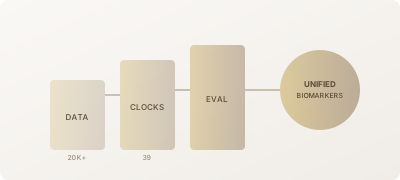
A Unified Framework for Systematic Curation and Evaluation of Aging Biomarkers
Presents a comprehensive framework for systematically curating and evaluating aging biomarkers, addressing the challenge of standardizing biological age measurements.
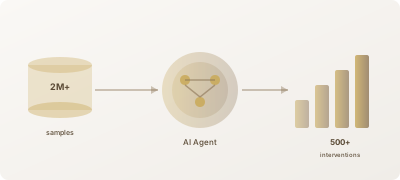
Autonomous AI Agents Discover Aging Interventions from Millions of Molecular Profiles
ClockBase Agent employs specialized AI agents that autonomously reanalyze 43,602 intervention-control comparisons, revealing 500+ interventions that significantly reduce biological age.
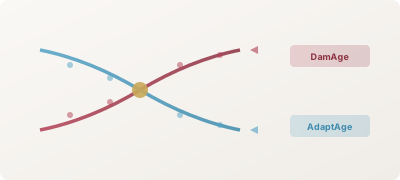
Causality-Enriched Epigenetic Age Uncouples Damage and Adaptation
Established a novel framework to introduce causal information into epigenetic clocks, creating DamAge and AdaptAge—clocks that track detrimental and adaptive methylation changes.
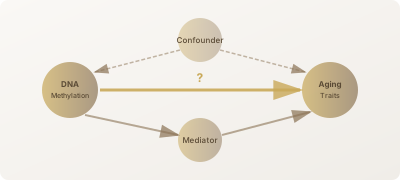
Causal Inference for Epigenetic Ageing
A perspective on applying causal inference methods to understand the relationship between epigenetic changes and the aging process.
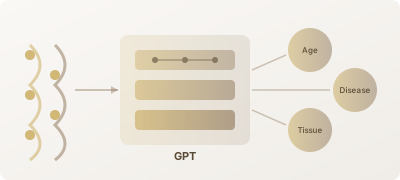
MethylGPT: A Foundation Model for the DNA Methylome
One of the first foundation models for DNA methylation data, enabling transfer learning and improved predictions across diverse epigenetic tasks.
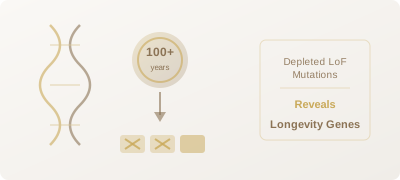
Depletion of Loss-of-function Germline Mutations in Centenarians Reveals Longevity Genes
Analysis of centenarian genomes reveals depleted loss-of-function mutations in specific genes, identifying genetic variants that contribute to exceptional longevity.
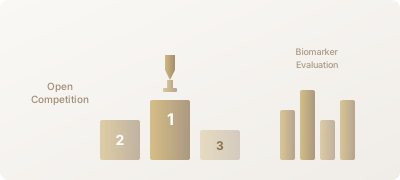
An Open Competition for Biomarkers of Aging
Organized a community-wide competition to benchmark aging biomarkers, establishing standardized evaluation protocols for biological age estimation methods.
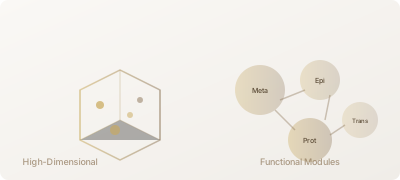
High-dimensional Ageome Representations of Biological Aging across Functional Modules
Develops high-dimensional representations of biological aging that capture aging signatures across multiple functional modules including metabolomics, proteomics, and transcriptomics.
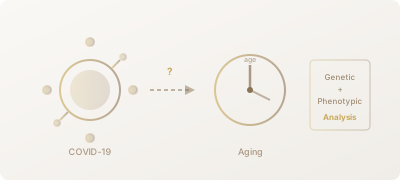
Genetic and Phenotypic Analysis of the Causal Relationship between Aging and COVID-19
Demonstrates that genetic variation associated with longer lifespan is linked to reduced COVID-19 risk, identifying key aging-related factors in disease susceptibility.


 2024-10
 2024-10


